Recipe Converter: How to Scale Any Recipe Up or Down
 By Eggcelllent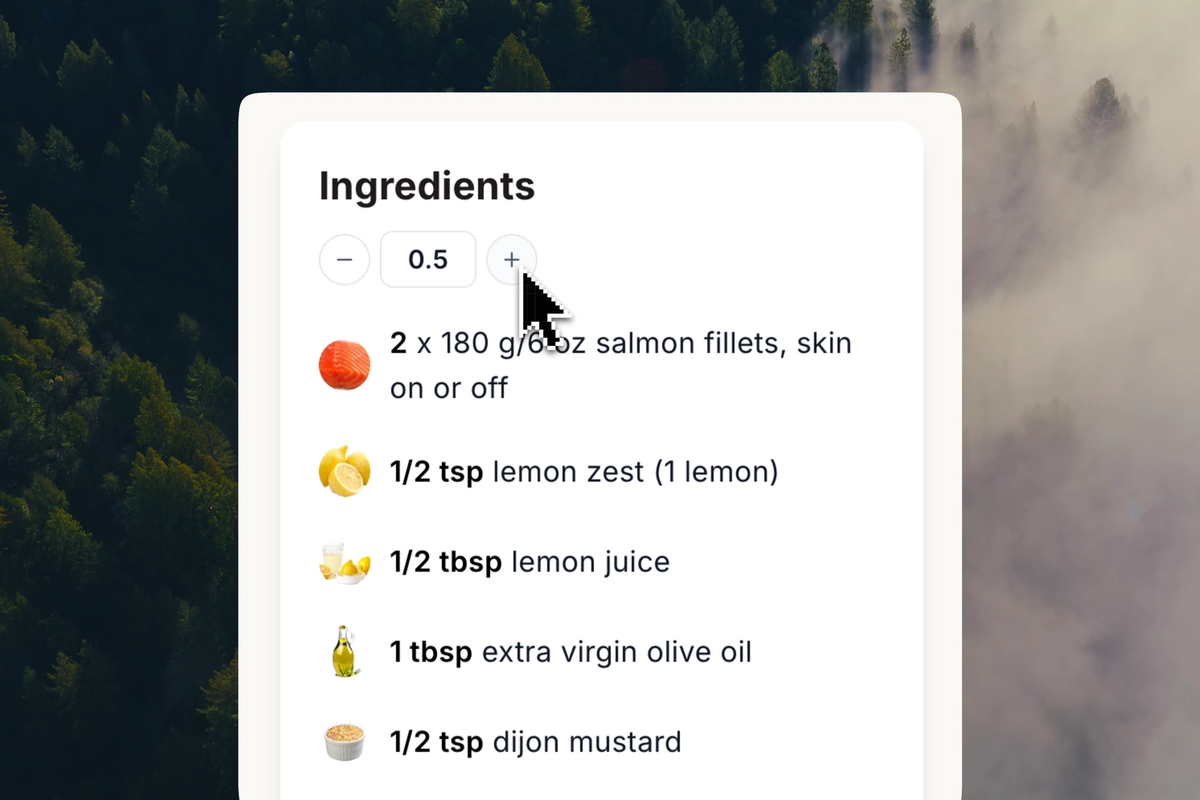
Whether you're cooking for a crowd or making a cozy dinner for two, knowing how to scale a recipe is an essential kitchen skill. This comprehensive guide will teach you everything you need to know about recipe conversion—from simple doubling to complex scaling calculations.
Imagine this: you've found the perfect chocolate chip cookie recipe, but it makes 48 cookies and you only need a dozen. Or perhaps you're hosting a dinner party and need to triple your famous lasagna recipe. Sound familiar?
Recipe scaling is something every home cook faces, yet many of us struggle with the math and end up with disappointing results. The good news? With the right approach and a simple formula, you can confidently adjust any recipe to fit your needs.
In this guide, we'll walk you through everything you need to know about using a recipe converter, from basic calculations to pro tips that ensure your scaled recipes turn out perfectly every time.
What Is Recipe Scaling?
Recipe scaling (also called recipe conversion) is the process of adjusting ingredient quantities to change how many servings a recipe produces. Whether you need to double a recipe, half a recipe, or convert servings to any custom amount, the fundamentals remain the same.
Think of it like this: if a recipe is a blueprint, scaling is simply resizing that blueprint while keeping all the proportions intact.
Common scenarios where you'll need a recipe converter:
- Cooking for more guests than the original recipe serves
- Making a smaller batch when cooking for one or two people
- Adjusting a restaurant-sized recipe for home cooking
- Converting a recipe to fit a different pan size
- Reducing waste by making only what you need
The Recipe Conversion Formula: Your Key to Accurate Scaling
The heart of every recipe multiplier is a simple mathematical formula. Once you understand this, you can scale any recipe with confidence.
The Conversion Factor Formula
Conversion Factor = Desired Yield ÷ Original Yield
That's it! This single calculation tells you exactly how much to multiply (or divide) each ingredient.
Step-by-Step Example: Scaling Up
Let's say you have a soup recipe that serves 4 people, but you need to feed 10.
- Calculate the conversion factor: 10 ÷ 4 = 2.5
- Apply to each ingredient: Multiply every ingredient by 2.5
If the original recipe calls for:
- 2 cups chicken broth → 2 × 2.5 = 5 cups
- 1 tablespoon olive oil → 1 × 2.5 = 2.5 tablespoons
- ½ teaspoon salt → 0.5 × 2.5 = 1.25 teaspoons
Step-by-Step Example: Scaling Down
Now imagine you want to make that same soup for just 2 people.
- Calculate the conversion factor: 2 ÷ 4 = 0.5
- Apply to each ingredient: Multiply every ingredient by 0.5
If the original recipe calls for:
- 2 cups chicken broth → 2 × 0.5 = 1 cup
- 1 tablespoon olive oil → 1 × 0.5 = ½ tablespoon (or 1.5 teaspoons)
- ½ teaspoon salt → 0.5 × 0.5 = ¼ teaspoon
Quick Reference: Common Recipe Scaling Multipliers
For everyday cooking, you'll frequently need these common conversions:
| Goal | Conversion Factor |
|---|---|
| Half a recipe | x0.5 |
| One-third of a recipe | x0.33 |
| One-quarter a recipe | x0.25 |
| Double a recipe | x2 |
| Triple a recipe | x3 |
| Quadruple a recipe | x4 |
Pro tip: Keep a calculator handy in your kitchen—or better yet, use a dedicated recipe conversion calculator to do the math automatically.
Measurement Conversions You'll Need
When scaling recipes, you'll often end up with awkward measurements. Here's a handy reference for converting between common kitchen measurements:
Volume Conversions
| Measurement | Equivalent |
|---|---|
| 1 tablespoon | 3 teaspoons |
| 1 cup | 16 tablespoons |
| 1 cup | 8 fluid ounces |
| 1 pint | 2 cups |
| 1 quart | 4 cups |
| 1 gallon | 16 cups |
Weight Conversions (for baking accuracy)
| Ingredient | 1 Cup Equals |
|---|---|
| All-purpose flour | 125g (4.4 oz) |
| Granulated sugar | 200g (7 oz) |
| Brown sugar (packed) | 220g (7.75 oz) |
| Butter | 227g (8 oz) |
| Milk | 240g (8.5 oz) |
Why weight matters: For the most accurate recipe scaling—especially in baking—convert volume measurements to weight using a kitchen scale. This eliminates measurement inconsistencies and produces more reliable results.
Ingredients That Don't Scale Linearly
Here's where recipe conversion gets tricky: not all ingredients behave the same way when scaled. Pay special attention to these:
1. Seasonings, Spices, and Salt
The rule: Start with 1.5x the seasoning when doubling a recipe, then taste and adjust.
Why? Salt and spices have a more concentrated impact as quantities increase. Doubling the salt in a doubled recipe can easily make it too salty.
Best practice: Add seasonings gradually and taste as you go. You can always add more, but you can't take it away.
2. Leavening Agents (Baking Soda, Baking Powder, Yeast)
The rule: Use approximately 1 to 1.25 teaspoons of baking powder per cup of flour, regardless of scale.
Why? Too much leavening causes baked goods to rise too quickly and then collapse. The chemistry doesn't scale proportionally with larger batches.
For yeast breads: When scaling up significantly, reduce yeast by about 20% to prevent over-proofing.
3. Eggs
The challenge: You can't use half an egg!
Solutions:
- Beat the whole egg, then measure by weight (1 large egg ≈ 50g or about 3 tablespoons)
- For recipes calling for 1.5 eggs, use either 1 or 2 and adjust liquid slightly
- Consider using egg substitutes for partial eggs
4. Liquids
The rule: When scaling up significantly, reduce liquids by about 10%.
Why? Evaporation rates change with larger volumes. A doubled batch doesn't evaporate twice as fast, so you may need slightly less liquid to achieve the same consistency.
Scaling Baked Goods: Special Considerations
Baking is where recipe scaling requires the most care. Here's how to get it right:
Pan Size Adjustments
When you scale a recipe, you often need to adjust your pan size. The goal is to maintain the same depth of batter as the original recipe.
General guidelines:
- Doubling a cake recipe? Use two pans of the original size rather than one larger pan
- Halving a recipe? Choose a pan with approximately half the surface area
- Use this formula: New pan area ≈ Original pan area × Conversion factor
Cooking Time Adjustments
Scaling up: Larger volumes may need slightly longer cooking times at a slightly lower temperature (reduce by 25°F/15°C) to ensure the center cooks without burning the edges.
Scaling down: Smaller portions cook faster. Start checking for doneness 25-50% earlier than the original recipe suggests.
The best indicator: Use a thermometer or the toothpick test rather than relying solely on time.
Baker's Percentages: The Pro Method
Professional bakers use baker's percentages to scale recipes precisely. Here's how it works:
- The flour weight is always 100%
- Every other ingredient is expressed as a percentage of the flour weight
- To scale, simply multiply the flour weight by your conversion factor, then calculate all other ingredients based on their percentages
Example:
- Flour: 500g (100%)
- Water: 350g (70%)
- Salt: 10g (2%)
- Yeast: 5g (1%)
To make 1.5x the recipe, use 750g flour, then calculate: Water = 750 × 0.70 = 525g, and so on.
Recipe Scaling Tips for Different Cooking Methods
Stovetop Cooking
- Sautéing: You may need to cook in batches even with a larger recipe to avoid overcrowding the pan
- Simmering: Larger volumes take longer to reach temperature; adjust timing accordingly
- Reducing sauces: Reduction time doesn't scale linearly—a doubled sauce won't reduce twice as fast
Oven Cooking
- Roasting: Multiple pans may be needed; rotate them for even cooking
- Casseroles: Use multiple smaller dishes rather than one massive one for better heat distribution
- Baking: As mentioned, watch temperatures and times carefully
Slow Cooker Recipes
- Fill level matters: Keep your slow cooker between half and two-thirds full for proper cooking
- Don't double liquid: When scaling up slow cooker recipes, increase liquid by only 1.5x when doubling
- Consider time: Larger quantities may need additional cooking time
Common Recipe Scaling Mistakes to Avoid
Mistake #1: Scaling seasonings directly
Problem: Your doubled recipe tastes way too salty or spicy.
Solution: Always add seasonings gradually and taste as you go.
Mistake #2: Not adjusting pan size
Problem: Your scaled-up cake has a raw center or your scaled-down cookies are paper-thin.
Solution: Match pan size to maintain original depth of food.
Mistake #3: Ignoring cooking time changes
Problem: Undercooked or overcooked results.
Solution: Use visual cues and internal temperature rather than relying on original timing.
Mistake #4: Using volume for baking
Problem: Inconsistent results, especially with flour.
Solution: Invest in a kitchen scale and measure by weight for baking.
Mistake #5: Trying to scale a recipe too dramatically
Problem: Recipe chemistry fails at extreme scales.
Solution: For very large quantities, make multiple batches rather than one enormous one.
Tools to Make Recipe Scaling Easier
Kitchen Scale
The single most valuable tool for accurate recipe scaling. Look for one that measures in grams for precision.
Recipe Conversion Calculator
Online recipe conversion calculators (like the one here at Eggcellent) do the math instantly. Simply input your ingredients and desired servings.
Measuring Cups and Spoons
A complete set is essential for working with scaled measurements. Consider sets that include odd sizes like ⅛ cup and ½ tablespoon.
Kitchen Notebook
Write down your scaled recipes and notes for future reference. Include what worked and what needed adjustment.
Frequently Asked Questions About Recipe Scaling
Can all recipes be scaled?
Most recipes can be scaled, but some are trickier than others. Baked goods, especially those relying on precise chemical reactions (like soufflés or angel food cake), are more challenging. Simple recipes like soups, stews, and salads scale easily.
How do I scale a recipe for a different pan size?
Calculate the area of both pans, then divide the new pan's area by the original pan's area. This gives you the conversion factor for your ingredients.
What's the easiest way to half a recipe?
Divide all ingredients by 2. For odd measurements like 3 eggs, beat eggs and measure half by weight (1 egg ≈ 50g, so use 75g for 1.5 eggs).
Should I scale cooking temperature when I scale a recipe?
Generally, keep the same temperature for recipes scaled up to 2x. For larger scales, reduce temperature by 25°F (15°C) and increase cooking time.
How do I convert cups to grams?
It depends on the ingredient. Use a conversion chart or search for "[ingredient] cups to grams" for specific values. A kitchen scale is the most accurate method.
Putting It All Together: Your Recipe Scaling Checklist
Before you scale your next recipe, run through this quick checklist:
- [ ] Calculate your conversion factor (desired yield ÷ original yield)
- [ ] Multiply all ingredients by the conversion factor
- [ ] Adjust seasonings conservatively (taste and add more as needed)
- [ ] Check leavening agent ratios for baked goods
- [ ] Solve any partial egg situations
- [ ] Select appropriate pan size(s)
- [ ] Plan for adjusted cooking time
- [ ] Have measuring tools and calculator ready
- [ ] Write down your scaled recipe for reference
Start Scaling With Confidence
Recipe conversion doesn't have to be intimidating. With the simple formula we've covered—Conversion Factor = Desired Yield ÷ Original Yield—and awareness of the ingredients that need special attention, you can confidently scale any recipe up or down.
Remember: cooking is as much about intuition as it is about precision. Use these guidelines as your foundation, but trust your senses too. Taste, smell, and observe your food as it cooks, and you'll develop an instinct for when adjustments are needed.
Ready to put your new skills to the test? Try our free recipe converter tool to instantly scale your favorite recipes to any serving size. No more mental math—just perfect portions every time.
Ready to extract your first recipe?
Try Eggcellent today and turn YouTube cooking videos into formatted recipes in seconds.
Get Started FreeRelated Articles
How to Use Eggcellent's Meal Planner to Organize Your Weekly Cooking
Meal Planning 101: A Beginner's Guide to Stress-Free Weekly Cooking
Smart Grocery List: How Aisle Mode Auto-Merges Your Ingredients